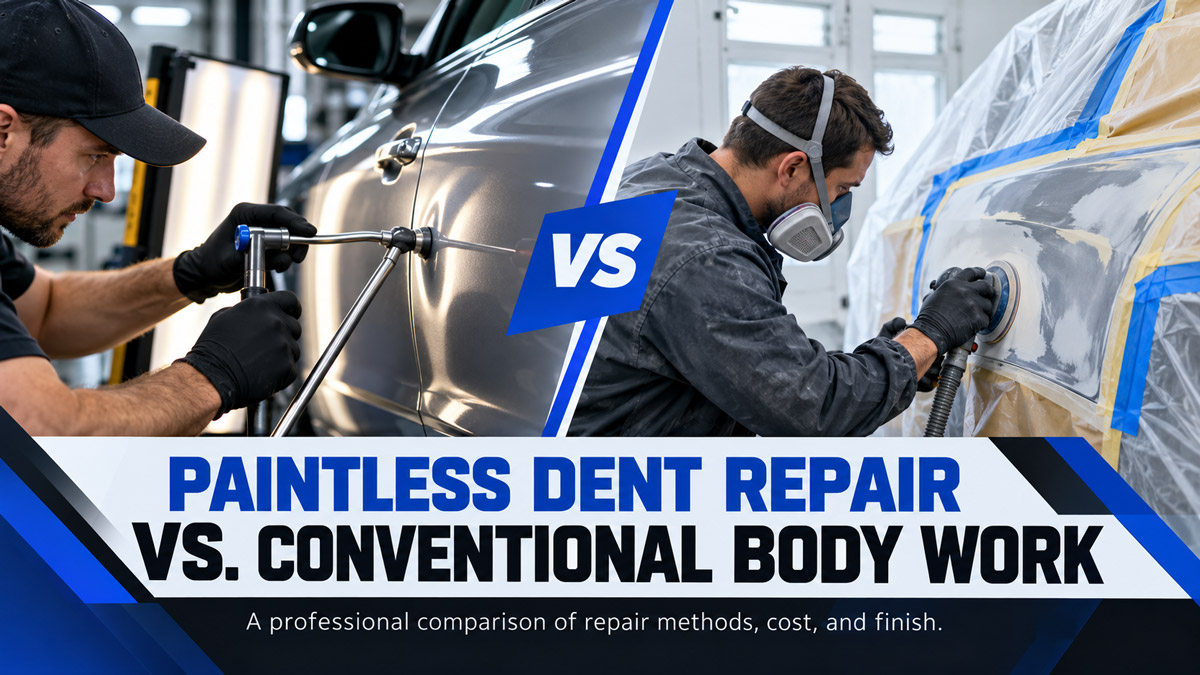
How the two methods differ, when each one fits, and why a good shop uses both.
When a car or truck has a dent, there are two broad ways to fix it. Paintless dent repair works the metal back into shape without filler or paint. Conventional body work reshapes the panel, fills and sands it, then primes and repaints it. Both are legitimate methods. The right choice depends on the damage, not on preference.
Paintless dent repair, often called PDR, uses rods, picks, and specialized lighting to push a dent out from behind the panel, or glue tabs to pull it from the front when the back cannot be reached. Because the original paint is kept, there is no color matching and no fresh paint to cure. On the right dent, it can be fast and cost-effective.
The key condition is intact paint. If the paint is cracked, chipped, or stretched beyond its limit, pushing the metal back will not restore the finish. PDR also needs reasonable access and metal that has not been creased too sharply. Large, sharp dents along a body line are often beyond what paintless methods can achieve.
Conventional body work handles what PDR cannot. A technician reshapes the metal as closely as possible, applies a thin layer of filler to level the surface, sands it smooth, primes it, and refinishes it to match the surrounding paint. Done well, the repair is invisible. It takes more time because of the material and paint steps.
Hail damage is where the two methods meet most often. Many hail dents are shallow with intact paint and suit PDR well. But a hailstorm can also crack paint on a hood edge or leave sharp dents on a roof rail. A shop that does both can repair each panel with the method that fits it, rather than forcing every panel through the same process.
J.R’s Automotive & Hail Repair describes itself on Google as a one stop repair shop specializing in automotive repair, hail repair, and collision work. Its archived About page described the team as specialists in hail damage repair as well as collision repair. That combination is the practical reason to ask a shop how it decides between methods.
Cost comparisons should be made on the same damage. A paintless repair is often less expensive than a conventional repair for the same small dent, but it is not cheaper if it cannot achieve the result. Ask the shop which method it recommends for each area and why.
Resale value is another consideration. Original factory paint is valued by many buyers, which is one reason paintless repair is popular when it fits. When it does not fit, a well-matched conventional repair is the honest answer.
Time is part of the comparison as well. A paintless repair on a few accessible dents can sometimes be finished the same day, because there is no filler to cure and no paint to dry. A conventional repair moves through more stages, and each coat of primer, base, and clear needs time before the next step. If you depend on the vehicle every day, ask how long each method would keep it in the shop.
Some repairs use both methods on the same panel. A technician might push most of a dent out with paintless tools, then finish a small sharp area with a thin skim of filler and a spot refinish. That hybrid approach can keep the repaired area smaller than a full conventional repair while still dealing with paint that has been damaged. It is worth asking whether that option applies to your dent.
Insurance adjusters understand both methods and often write hail estimates that mix them. If your estimate lists paintless repair for most panels and conventional repair for one or two, that is usually a sign the adjuster has looked carefully. The shop can explain each line before the work begins.
The simplest way to know which method suits your vehicle is an in-person look under good light. Photos can start the conversation, but the technician needs to see the paint, the dent’s edges, and the access behind the panel before giving a confident answer.